 Skip to content
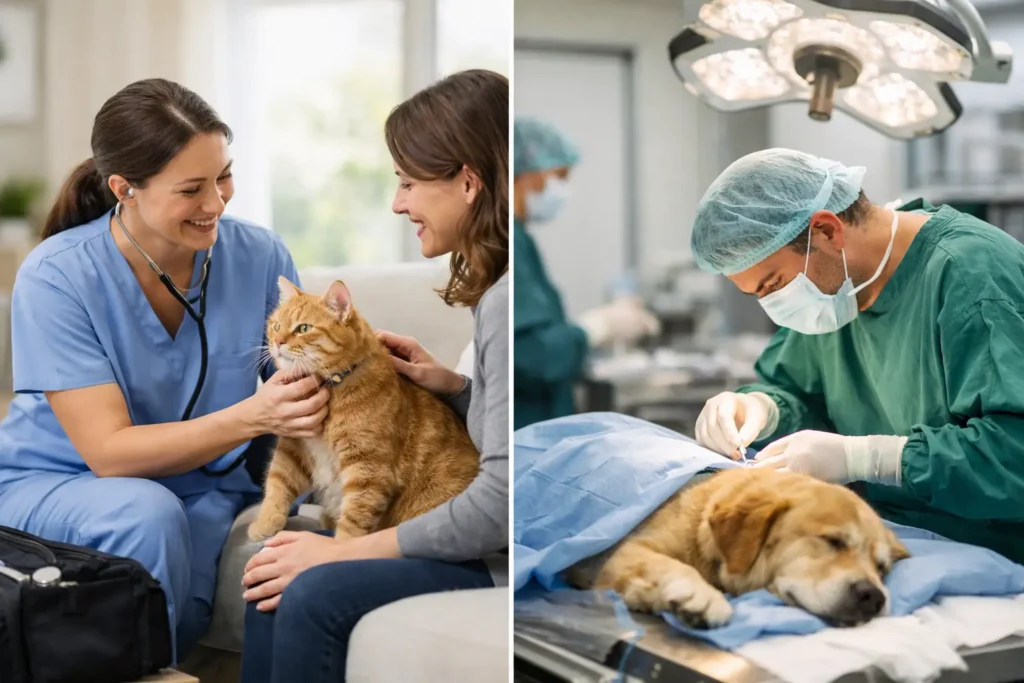
A trembling dog in the car park, a cat who disappears beneath the bed at the sight of the carrier, or an elderly rabbit distressed by a journey can make even a routine appointment feel overwhelming. When considering a home visit vet versus surgery, the right choice is not about convenience alone. It is about the type of care your pet needs, their comfort, and whether the setting can safely support the treatment required.
For many appointments, veterinary care at home offers a calmer, kinder experience. For others, a veterinary surgery has essential equipment and a wider clinical team close at hand. Understanding the difference can help you make a decision with confidence, particularly when your pet is unwell or approaching the end of life.
A home visit brings a qualified veterinary professional to your pet in the place they know best. There is no car journey, waiting room, unfamiliar smells or contact with other animals. This can be particularly valuable for anxious pets, animals with limited mobility, multi-pet households and families who find travelling difficult.
A veterinary surgery is designed to support a broader range of investigations and treatments. It may have diagnostic imaging, laboratory equipment, surgical facilities, hospitalisation areas and several members of the clinical team available at once. If a pet needs intensive monitoring, urgent procedures or complex diagnostics, this environment can be the safest option.
Neither setting is automatically better. The most appropriate choice depends on the reason for the appointment and your pet’s current condition.
Home visits are well suited to many preventative, ongoing and comfort-focused veterinary needs. A calm environment can make it easier to assess a pet’s normal movement, appetite, behaviour and interaction with their family. These details can be highly useful when discussing subtle changes in health or quality of life.
Routine services can often be delivered effectively at home. This may include annual vaccinations, health checks, prescription reviews, parasite treatment, microchipping, pet travel documentation and recurring therapeutic injections such as Librela, Solensia, Cytopoint or Suprelorin. Breeders may also find home visits particularly practical for litter vaccinations and microchipping, avoiding the challenge of transporting several young animals to a surgery.
For pets who are fearful, reactive or physically uncomfortable, remaining at home can prevent distress before the appointment even begins. A dog with arthritis may struggle to get into the car. A cat may become so frightened by travel that their examination is less representative of how they are normally feeling. An experienced mobile veterinary professional can work patiently within the home, allowing time for the pet to settle where possible.
Home can be an especially gentle place for conversations about a pet’s declining health. Families are often better able to speak openly when they are not in a busy reception area or trying to manage an anxious animal at the same time.
A quality-of-life assessment considers more than one symptom. It looks at comfort, mobility, appetite, hydration, toileting, enjoyment, anxiety and the balance of good days against difficult ones. There is rarely one perfect moment or one simple score that makes a decision for you. Instead, veterinary guidance can help you understand what your pet may be experiencing and what compassionate options are available.
For many families, at-home euthanasia is the clearest example of when a home visit may feel right. A pet can remain in their favourite bed, on the sofa beside their person, or in a quiet spot in the garden if appropriate. They are surrounded by familiar voices, scents and love, rather than having to make one final stressful journey.
This does not make the decision easier emotionally, but it can make the experience gentler. A qualified veterinary professional will explain each stage, give your family time, and place your pet’s comfort at the centre of every decision. Arrangements for individual or communal cremation can also be discussed, so you are not left to navigate practical details alone at an already painful time.
A home visit is not a replacement for every kind of veterinary care. A responsible mobile service will always be clear when your pet needs a surgery, emergency hospital or referral centre.
If your pet has collapsed, is struggling to breathe, has uncontrolled bleeding, has suffered a serious injury, is having repeated seizures, or seems suddenly severely unwell, they may need urgent hospital-based treatment. The priority in these situations is rapid assessment, pain relief, stabilisation and access to equipment that cannot be brought into a home.
Surgery may also be preferable where tests are needed immediately. Blood analysis, X-rays, ultrasound, oxygen therapy, intravenous fluids, anaesthesia, dental procedures and operations generally require clinic facilities. Some pets need to stay in hospital for observation after treatment, especially if their condition may change quickly.
A mobile vet can still be an important first point of contact in some circumstances. Telephone enquiries answered by veterinary nurses can provide immediate triage support and help you understand whether a home appointment is suitable or whether your pet should be seen urgently in a clinical setting. If you are worried, it is always better to ask early than wait and hope the problem settles.
It is understandable to focus on whether your pet dislikes travelling. Yet the decision should begin with a different question: what does this appointment require?
For a vaccination, wellbeing check or ongoing injection, home may offer the same clinical purpose with much less stress. For a painful lump that may need sampling, a home consultation may be useful for an initial assessment, but further testing at a surgery could still be recommended. For a pet with vomiting and diarrhoea who is otherwise bright, the best route will depend on their age, hydration, symptoms and medical history. A young puppy, frail senior pet or rabbit can become unwell more quickly than owners expect.
It also helps to consider your home environment honestly. Most pets relax at home, but some become protective of their space or unsettled when visitors arrive. Let the veterinary team know if your dog is nervous with strangers, if your cat is likely to hide, or if there are other animals in the household. Small preparations can make a significant difference.
A quiet room with good light is usually ideal. Keep your pet comfortable and avoid forcing them from a favourite resting place unless necessary. For cats and rabbits, it can help to close doors early so they cannot disappear into an inaccessible hiding place. If your pet has a history of biting, fear or reactivity, share this when booking so the team can plan safely and kindly.
Have any current medication, vaccination records and relevant notes available. It is also useful to write down changes you have noticed, such as reduced appetite, stiffness after rest, altered drinking habits, weight loss or disturbed sleep. During an emotional appointment, these details can be easy to forget.
For an end-of-life visit, there is no need to make the home look a certain way or prepare a formal space. Choose somewhere your pet is comfortable. Some families want everyone present; others prefer one person to stay close. Both are valid. The veterinary professional will guide the practical side with calm, respectful care.
The best care is not defined by a postcode or a building. It is defined by good clinical judgement, clear communication and a plan that protects your pet’s welfare. At Vets 2 Your Pets, home-first care is delivered by experienced veterinary professionals, with clinical support and triage to help families understand the most appropriate next step.
Sometimes that step is a peaceful appointment in familiar surroundings. Sometimes it is a prompt recommendation to attend a surgery with the facilities your pet needs. Being advised to seek clinic care is not a failure of home veterinary medicine – it is part of putting your pet’s safety first.
If you are uncertain, describe what you are seeing rather than trying to diagnose it yourself. Tell the team when the change began, whether it is getting worse, and how your pet is behaving between symptoms. Clear, early information gives you the best chance of choosing a setting where your pet can receive the right care with the least possible stress.
The kindest choice is often the one that lets your pet feel safe while ensuring they have the clinical help their condition requires.
Covering multiple regions with rapid response times and expert clinicians who know your area.
Our friendly team is always ready to support you. Our mobile veterinary service brings professional care straight to your home, making veterinary visits more convenient and pleasant for you and your pet. Whether you need advice, routine care, or treatment, we’re here to answer your questions and provide a calm, personalised service in the comfort of your own surroundings.
If you’re considering pet euthanasia at home and want to understand the process, costs, or aftercare options, or if you’d like to know more about our other services, please reach out to our experienced team today.
If you’re considering pet euthanasia at home and want to understand the process, costs, or aftercare options, or if you’d like to know more about our other services, please reach out to our experienced team today.

Vets 2 Your Pets
Vets 2 Your Pets
Send us a message and we'll get right back to you.
